by Mike Pane | Sep 5, 2023 | Battery Storage Systems, Solar Installation, Solar News, Uncategorized
Leading the Move to Energy Storage
Synergy leads the industry in solar battery systems and has installed them for over a decade. We stay ahead by adopting new battery technology as it develops. Batteries provide so much value that we stopped installing solar without storage in 2019. We still make rare exceptions, but storage has become the standard for most projects. This shift reflects rising utility rates, new tariffs, and the growing need for energy resilience. Synergy’s experience helps homeowners choose systems that fit their goals and protect their investment.
Utility Tariffs
Utilities use tariffs to determine how they credit exported solar power. The first tariff was NEM1 and the second was NEM2. New customers now use the Net Billing Tariff, called NBT. Homeowners who lose their original NEM status also move to NBT. These changing tariffs strongly affect solar savings. Batteries help reduce the impact of lower export rates under newer tariff structures. Understanding these rules helps homeowners make better decisions about storage.
Two Fundamental Designs
Battery systems follow two main designs and each design supports different goals. A backup battery powers selected loads when the grid fails. A savings battery stores excess solar and lowers your bill. Savings batteries discharge during expensive peak periods and at night. Under NEM1 and NEM2, savings were modest. Under NBT, savings batteries have become essential. They increase bill offset and shorten payback. A backup system under NBT needs a larger battery to handle outages and self-consumption. You can add backup ability later without changing your NEM or NBT status.
Understanding Battery Sizing
Battery sizing uses two ratings: kW and kWh. kW measures how much power a battery can deliver at once. kWh measures how long the battery can deliver that power. These ratings guide proper design choices. If you want more detail, we created a separate blog that explains these units that you can read here. Reviewing those basics can help you better understand the designs below.
Backup Battery Design
A backup battery system powers key loads during a grid outage. This design usually needs more equipment and a larger battery. It uses a transfer switch to isolate your home from the grid during outages. This protects utility workers and meets code requirements. We move essential circuits into a backup loads panel during installation. These circuits often include refrigeration, lighting, and internet. Most backup systems also support daily self-consumption. A backup reserve protects stored energy for outages. If you set a 70% reserve, the system cycles only 30% each day to save money and will always have 70% available for outages.
Meter Collars for Whole-Home Backup
New meter-collar products now support whole-home backup at a lower cost. They reduce extra equipment and installation labor. They also power more loads during outages. Some systems require more monitoring because more loads can run at once. Several manufacturers now offer smart controls. These controls automatically turn off large loads when the grid fails. This protects the battery and extends runtime during long outages.
Savings (Grid-Tied) Battery Design
A savings battery focuses on bill reduction instead of outage protection. It stores extra solar produced during the day and discharges during peak pricing. It also can run at night when solar is not available. Savings batteries do not require a transfer switch or a backup loads panel. Some systems, like Enphase, remove the transfer switch (system controller or meter collar) which reduces labor and material cost. Savings systems do not hold energy for outages. They often discharge down to 5% and use more capacity each day. This lets homeowners choose a smaller and more affordable battery.
by Mike Pane | Aug 30, 2023 | Battery Storage Systems, Uncategorized
Understanding kW and kWh in Battery Storage
Many people don’t understand the difference between kW and kWh, but the distinction matters. These two ratings appear on every battery system and help determine proper sizing. A useful analogy using a car compares kW to engine horsepower and kWh to a fuel tank size or EV driving range. “Kilo” means one thousand, so one kilowatt equals one thousand watts and one kilowatt-hour is 1,000 watts used over an hours time.
Whats a kW
A kW rating measures power, which shows how much electricity a device or battery can deliver at one time. A 1,000-watt microwave needs 1 kW to operate. A battery’s kW rating determines what you can run at the same time during an outage. Batteries also include a surge rating in kW, which handles short bursts of extra power. Surge ratings matter when starting pumps or motors that need higher startup loads.
Whats a kWh
A kWh measures energy used over time. A 100-watt bulb running for ten hours uses 1 kWh. A battery’s kWh rating shows how long it can supply power during an outage. This duration depends on which loads you use and how long they run. Your utility bills also track energy in kWh. Most home battery names use kWh as the main identifier. The Enphase 10C stores 10 kWh. Most systems allow stacking to increase total capacity as needed. Enphase 10C batteries can stack to 80 kWh. Some battery systems also increase power output (kW) as capacity (kWh) grows.
by Mike Pane | May 4, 2023 | Uncategorized, Solar News
Have you seen the news the last few years around changes to the future of solar in California? These changes affect new solar customers who submit applications to the utility after April 14th, 2023, with a few exceptions for new construction projects. Under NEM 3, also known as “Net Billing”, the value of the “excess” solar that is produced and exported to the grid (spinning the meter backwards) will lose around 75% of its value-but all is not lost.
Jeff Mathias, previous Synergy Co-owner wrote an informative blog about why solar still makes financial sense under the new NEM 3 program.
Do you think that you missed out on installing solar if you did not get an application in before the deadline? To find out why that is not the case read Jeff’s blog here.
by Synergy Solar | Jun 15, 2021 | Uncategorized
Based on customer requests and system enhancements, Sonnen will be upgrading your Sonnen Firmware to level 1.6 in June of 2021. This new firmware release will have more user friendly screen information and may require you to re-align the screen. Please see the attached instructions as this was designed to be easy and customer modifiable.
Sonnen Calibration Instructions

by Synergy Solar | Apr 24, 2020 | Uncategorized, Battery Storage Systems
Grid-tied storage or off-grid – which is best for you?
 I often get calls from folks saying they are tired of their utility company and want to go off-grid, meaning they want to be completely self-sufficient and separate from the utility. Once we have a conversation regarding what this would actually mean, these folks usually change their mind. Off-grid does have a place. If you live in a remote location, often it is cost prohibitive to have the utility run electrical service to your home. First let’s look at an example of what a truly off-grid homes look like.
Almost a decade ago, Synergy did install off-grid systems. We have transitioned to only installing grid-tied solar and storage systems due to demand and focused expertise. Most of the off-grid systems we installed were located in the remote areas of Cazadero, Healdsburg and even a few in Sebastopol. These systems were installed because the cost to bring in power from the utility almost always exceeded $100,000, and because the projected power needs were limited. These homes did not have pools or hot tubs and often used propane to heat their homes, their food, their water and even had propane refrigerators.
Folks who choose the off-grid lifestyle do so due to the financial costs of running power to remote properties, knowing they will be giving up many modern conveniences and that they will need to pay close attention to how they use power. While battery technology has improved, more homes are also moving towards all electric appliances and electric vehicles, making off grid still financially and functionally prohibitive.
Most of the time when folks tell me “I want to be off-grid,” the number one reason for their choice is that they are tired of paying high energy prices. (PG&E, which services most our county, has some of the highest costs in the country). In most of the solar and storage analysis proposals I do, utility costs are 20-40% lower with solar and storage. The added bonus of having power when the grid is down provides some independence. Solar and storage also often eliminates the financial need of adding a generator and fueling the generator. To be clear, these solar and storage customers are still connected to the grid, but their costs are much lower because they are exporting power when production exceeds consumption (for credit) and bring in power only when consumption exceeds production. In a properly designed system, when usage is monitored carefully, utility costs could be very low, but the utility would still be available for high energy usage times.
The second most common reason folks say they want to go off-grid is that they are angry with their utility or no longer trust the grid’s reliability. The anger here in Sonoma County is primarily because the fires that have ravaged our area are often caused by downed utility power lines. There is tremendous lack of trust created by the Public Safety Power Shut-offs (PSPS), designed to mitigate fires. PG&E has instigated PSPSs as many as six times in some areas and lasting up to six consecutive days in 2019. Usually, once these customers understand the amount of solar and storage that would be required to maintain their pools, ponds, hot tubs, electric cars, heat pumps, AC, and other high-usage electricity devices, they are unwilling to reduce their usage enough or change their life styles to make going off-grid realistic. Emotions run high here in Sonoma because there has been great loss. Sometimes the emotions interfere with our ability to recognize how much we rely on power provided by the utility. If you are thinking of going off-grid, start by taking into consideration what your usage requirements are to be comfortable. It’s bearable to reduce and monitor usage short term, but having it as a lifestyle is a very different thing.

In a well-designed, grid-tied, solar plus storage system, we can fulfill most of a homeowner’s desire for energy independence. Solar power can generate most of the power a customer needs, and grid-tied storage systems allow us to store excess production for use later into the evening. Some homeowners use their storage batteries to self-consume their solar power, minimizing reliance on the grid to only those times they have high electricity demands. The bonus is when the grid is down for an outage or a PSPS, the homeowner with a storage system can continue to run their refrigerator, router, TV, garage door, or well pump. Adding storage to solar also helps future-proof solar systems because it minimizes the need to export solar power or import it from the utility, hence greater independence.
Another reason given for going off-grid is a customer’s desire to better the environment. For years, solar provided clean renewable energy to the grid when it was needed most (the middle of the afternoon). However, in the past few years, so much solar has been installed that the peak power draw from the grid is no longer in the middle of the afternoon but is now in the early evening when solar is not producing. To compensate, utilities fire up natural gas powered “peaker plants” to off-set this early evening demand. While solar still provides clean renewable energy during the day, the limitation on when it is produced causes issues on the grid. The answer is pairing solar with storage. Rather than exporting solar power to the grid mid-day when it is not needed, the solar power can be stored in your home’s battery to be used in the evening when it is needed. This off-sets a customer’s higher cost power and the need for “peaker plants”. Solar plus storage systems are designed to allow a homeowner to first use solar power, then charge the batteries, and finally to export the power to the grid. In the evenings, a homeowner will first use battery power and then utility power. This is an environmentally preferable scenario without having to go completely off-grid.
Grid-tied solar and storage systems are environmentally friendly compared to off-grid systems for several reasons. For off-grid systems on summer days, when the solar is producing a lot of power, once the  batteries are full, the solar power is curtailed or wasted since it has nowhere to go. Grid-tied systems will export power once the batteries are full so the solar power can be used by others. With off-grid systems, the system is sized for the worst solar day of the year, which often requires more resources and generators. Grid-tied systems use the grid to “balance” loads during these low solar production times, drawing from the grid when need is high, or during rainy weather when solar produces minimally. This minimizes the extra resources and generators that an off-grid system needs.
Another reason given for going off-grid is that homeowners want the latest technology. Solar and storage are no longer for the pioneer, but has become mainstream in most areas. Homeowners are setting the foundation for a distributed generating system, which will eventually replace the centralized utility model we have lived with for over a century. This type of change also happened in the early 80’s and 90’s as personal computers, tablets and cell phones replaced the central computer model. Local generation of solar and locally storing power with storage, allows homeowners to first use solar power, then charge their batteries and finally to export the power to the grid. As more solar and storage is installed, the current grid will no longer become our energy backbone, but instead will provide back-up power when needed and allow the flow of energy when and where it’s needed (Like the cloud for computers).
In summary, when I hear a customer say they want to be off-grid, my first question is “Are you currently connected to the grid?” In my experience if they are connected, they do not want to be off-grid, but they do want to lower/stabilize their costs, have back-up power when the grid is down, and/or to be more environmentally sustainable. I encourage all to see how they can be a part of this trend towards distributed generation and storage as it is not only financially advantageous, but often the right thing to do.

by Synergy Solar | Apr 11, 2020 | Uncategorized, Battery Storage Systems
One of the common trends in the residential building community is what I term “fuel switching”. The concept of fuel switching is the movement away from fossil fuels like natural gas, propane, diesel and gasoline in favor of electric sources. This is being done in the fight to reduce global warming and reducing carbon that is released when fossil fuels are burned. New research shows that one of the biggest greenhouse gases causing global warming is the methane (EPA). Methane is released during the harvesting of natural gas and the leakages in the distribution systems of natural gas. These can be over one hundred times worse for global warming than what comes out of a car’s tailpipe.
So how does switching to electric appliances help reduce our carbon footprint? In Sonoma County, our generation company, Sonoma Clean Power, is taking major steps to increase the usage of renewable energy to reduce the reliance on fossil fuels. They offer electric plans which are over 90% carbon free to their standard customers, with an option for 100% carbon free and renewable at an additional cost (Evergreen). The idea is that as they move closer to 100% carbon free, the improvement is seen by all their users, and has a more significant impact.
If you are planning on adding a battery storage system to your home, ensure your future decisions for fuel switching are considered into the mix when sizing your system. Let’s look at some examples of fuel switching some common appliances in a home and see how these changes could affect battery storage.
- Change hot water heating from natural gas-propane (NG-P) to electric heat pumps or electric water heating.
Many propane (NG-P) water heaters have a pilot light requiring no electrical needs. New NG-P water heaters and on-demand water heaters require a very small electrical usage for the gas igniter.
When calculating storage needs of an all-electric water heater, it is important to consider the electrical requirements because the surge and kilowatt usage of heating water with electricity can be significant. The two primary types of electric water heating are standard electric tank water heating and newer electric heat pump water heating. I would highly suggest heat pump water heaters because even though the upfront cost maybe higher, they are significantly more efficient than standard electric water heaters. While all devices vary, heat pumps typically use a third as much energy (1,500-2000 watts per hour) as the older electric technology (3,500-5,500 watts per hour). If you want hot water in an outage, make sure your storage system can handle this increased load for whichever water heater you select.
- Change space heating from forced air furnaces to heat pumps and mini-splits.

Many homes have a forced air furnace run by natural gas and propane (NG-P). When we tie these appliances to battery storage, we need to include the igniter (a small load) and the blower fan (usually a medium load). Fuel switching space heating requires a little thought. A whole house heat pump that replaces a gas furnace and uses the existing venting to heat or cool the home (they can also replace A/C). These units are usually 40-70-amps which is too large for most storage systems. If you want a whole house heat pump, an alternative heating source (wood or NG-P fireplace, space heater or mini-split) needs to be designed into the system for when the power is out.
At my home I have installed a mini-split (not vented) heat pump that runs on 20-amps and is very efficient. Mini-splits can be installed as a supplemental heater (like in my home) or multiple splits installed for the whole home heating needs. Because these units are usually 20-amps or less, a single mini-split can often be backed up with the proper storage design.
- Change a gas stove to an induction stove.
NG-P stoves and ovens are being replaced with electric ovens and induction cook-tops. These electric substitutes are 40-50 amps and not the best options for battery storage. The primary cooking devices we connect into the battery storage in these situations are the microwave and kitchen plugs (to use an induction hot plate). Many of my customers have come up with some very creative solutions during an outage including using the barbeque more and propane cook stoves.
- Change a personal car or motorcycle from gas or diesel to electric.
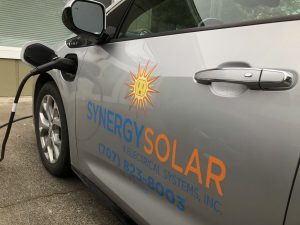
Electric transportation, while still a small percentage of total transportation, is growing fast and makes sense for both the environment and when homeowners have solar. Most electric vehicles (EV) have timers that allows them to choose the most efficient time to charge, usually in the early morning. If we tie the EV chargers to our storage system and the power goes out while we are sleeping, the entire home storage battery could be transferred into the vehicle. One solution we use in our design, is to install a garage or outside 110 v plug so that we can trickle charge the EV, usually after the home storage is fully charged by the solar. Also since most EV chargers are 30-100-amps, most are to large for storage systems.
- Change those personal 2-stroke power tools, weed-whackers, chain saws and leaf blowers to the electric or manual counterpart.
Since this is usually a minor electrical load it can be easily designed into any home storage system.
- Changing out your gas clothes dryer to an electric dryer or manually hanging clothes.
Usually electric clothes dryers are not put on storage systems, as hanging clothes is an easy option. It is possible with a properly sized system and a little manual control (turning off other unneeded loads) to have a clothes dryer as part of the design.
All-electric appliances and electric transportation are becoming the trend. Cities like Berkeley and Santa Rosa are no longer allowing gas appliances for new home building. Many auto makers are transitioning to all electric models over the coming decade. And more and more research points to the harmful effects of methane on our environment. I think it is safe to say, the move to electric appliances powered by renewable energy and away from fossil fuels in our homes and vehicles is a question of not if, but when. At Synergy, these are important parts of the design process. In preparation for these more environmentally sound power sources, we must anticipate the need, be creative and design our storage systems accordingly.

